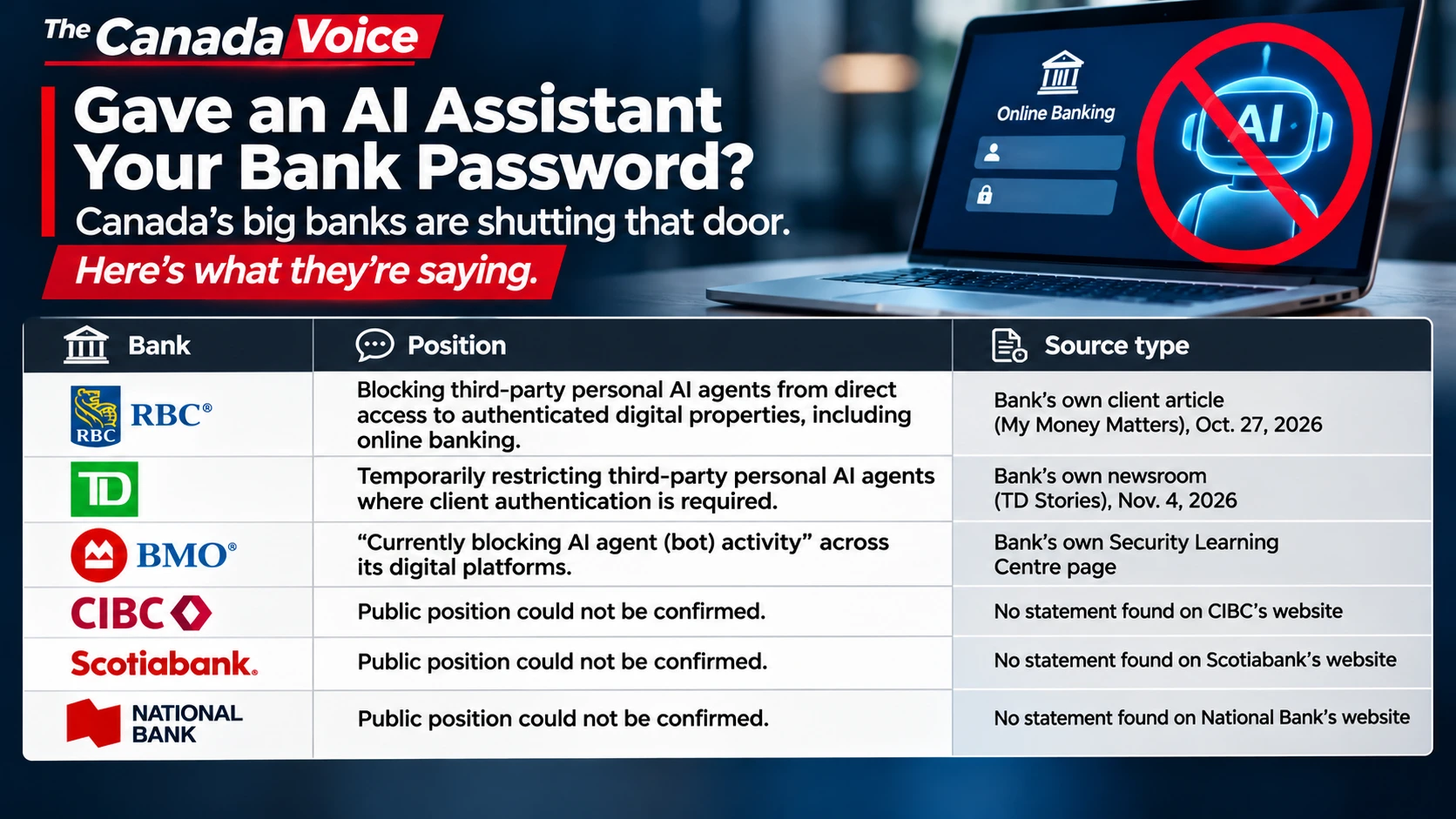
Who has said what
Royal Bank of Canada, the country's largest lender, posted a notice to clients on Oct. 27. "After careful consideration and based on what we know today, RBC has decided to block third-party personal AI agents from direct access to authenticated RBC digital properties including online banking," the bank wrote. It warned that existing agent connections "will stop working."
TD Bank and BMO have since published their own notices. The Canada Voice also checked the websites of CIBC, Scotiabank and National Bank of Canada but found no public statement on AI agents from any of them.
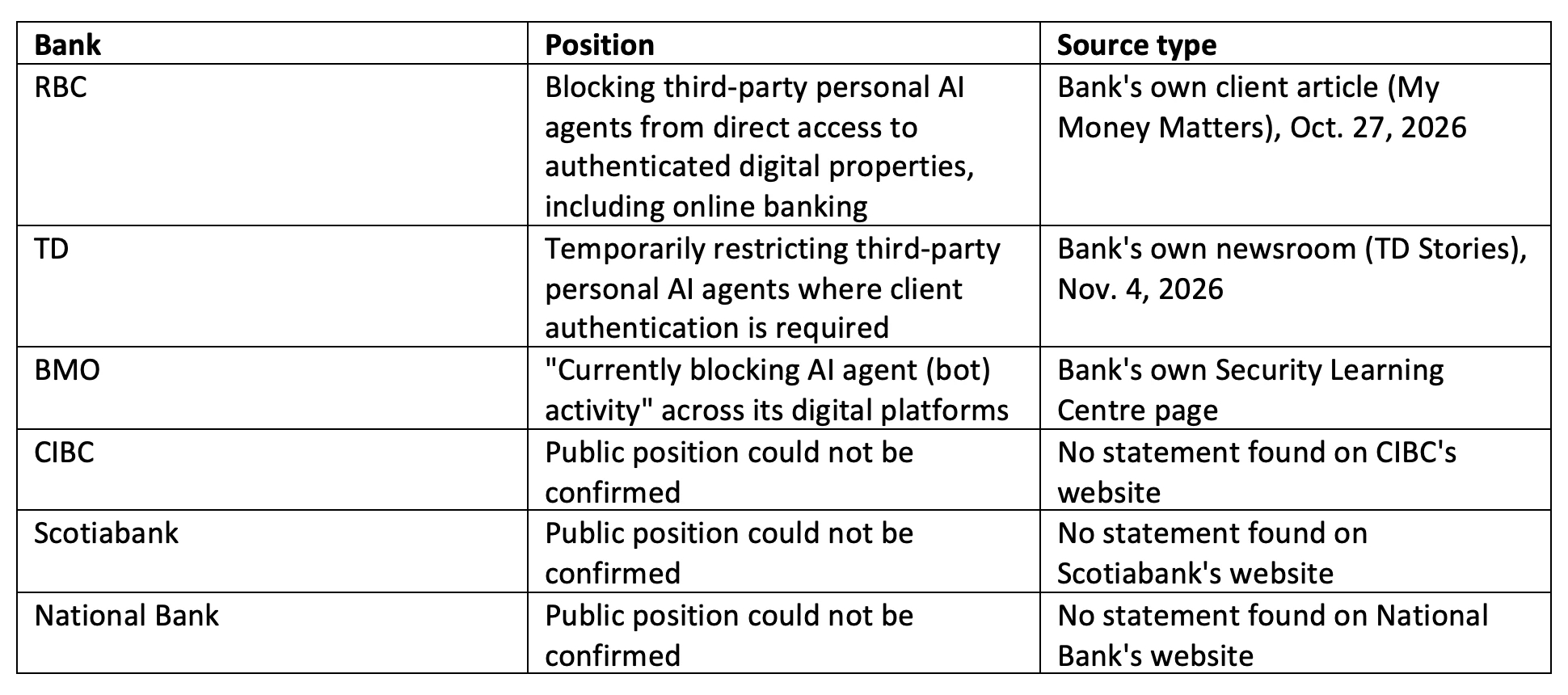
TD said it is "introducing measures across TD systems to help temporarily restrict third-party personal AI agents from directly accessing banking information where client authentication is required." Vlad Shpilsky, TD's group head of global technology and solutions, said in the same article: "AI agents have enormous potential to make managing money simpler and more intuitive. But when this technology is acting on a client's behalf, their privacy, security and control come first."
BMO's notice says some people are giving AI agents their login details, and that when they do, "they expose confidential information and may not be able to fully control what the agent does for them." The bank calls the block "a security measure, not a problem with your account."
Why banks are worried
AI agents go beyond chatbots. Meta, for example, says its Muse agent "can open a browser, fill out forms, and negotiate on their behalf," and that credentials a user shares are kept in secure storage so the agent can use them. None of the bank notices quoted here names a specific product.
For banks, an outside tool signing in with a customer's password is hard to tell apart from the customer. The tool also sits outside the bank's control. TD says agent access "raises questions about authorization, privacy, security, and oversight."
Liability is a big part of the picture. RBC's Digital Banking Security Guarantee, set out on the bank's website, excludes losses where a client shares "any of your Passwords or Personal Verification Questions" or where a client "consent[s] to, contribute[s] to or authorize[s] a transaction in any way." A customer who gives an AI tool their password could find a disputed transaction falls outside that protection.
The regulator's stance
The Office of the Superintendent of Financial Institutions (OSFI), which oversees federally regulated banks, has not issued a rule on customer-facing AI agents. In a published fireside chat at the 2026 Tech Festival in Toronto on Oct. 27, Superintendent Peter Routledge said: "OSFI takes a risk-based, principles-based and proportionate approach to responsible AI adoption." He added that its approach is "pragmatic and adaptive, focusing on outcomes rather than prescribing rules for every new development."
Routledge pointed to OSFI's existing guidelines: B-13 on technology and cyber risk, B-10 on third-party risk management, and E-21 on operational risk and resilience. He also referred to OSFI's technology risk bulletins on AI.
OSFI's July 2026 bulletin on generative and agentic AI warns that "excessive permissions increase the risk of unauthorized actions." It also flags "the use of shared or inherited credentials that undermine accountability." It suggests that institutions include AI misuse scenarios "such as, prompt injection" in their threat testing, and that they apply "approval checkpoints for high-impact actions."
A different approach south of the border
Large U.S. banks have also acted, but their published terms take a somewhat different shape. They tend to combine restrictions with rules that put responsibility on customers.
JPMorgan Chase's Digital Services Agreement, effective Oct. 27, 2026, says outside parties "including External AI, automated tools, or data aggregators" are "prohibited from using your Login Credentials." The agreement allows such tools to reach account data "through approved application programming interfaces ('APIs') with your authorization." It also says that a customer who lets an outside party, including an AI tool, into their accounts is deemed to have authorized that party's transactions.
Wells Fargo's updated Online Access Agreement, effective Nov. 24, 2026, adds a section on AI agents. If a customer gives an AI agent their login credentials or otherwise authorizes it, the agent's instructions "are deemed to have been initiated and authorized directly by you, without further verification." The same section lets the bank require customers to register AI agents, and to "limit, prohibit, prevent, suspend, or terminate access by any AI Agent."
So while the Canadian banks that have spoken publicly lead with blocks, the U.S. agreements reviewed by The Canada Voice spell out that, where agents get in, the customer bears the risk.
What's next
The Canadian banks present their measures as tied to where the technology stands today. TD says it will "continue to assess how they interact with TD and explore opportunities to enable trusted experiences" as different types of agents and industry standards emerge. BMO says it will "keep looking at how AI can serve our clients safely." RBC says its decision is "based on what we know today."
For now, the banks' advice is consistent. Use official bank apps and websites. TD says customers should never share a "username, password, PIN, or one-time passcode with an AI agent or anyone else."